A simple, repeatable framework to help you meet stressful moments with more calm, clarity, and self-trust. PAUSE stands for Pause, Accept, Understand, Strengthen, and Evolve.
The PAUSE Method: A Practical Guide to Emotional Resilience
About the PAUSE Framework: PAUSE is an original framework created by Diane Corriette, Personal Growth Coach and founder of Inspirational Guidance. It was developed from over two decades of coaching experience and personal practice, distilling what consistently helps people move from reactive to responsive when life gets difficult. This page is the home of the framework, and every step links to a deeper guide.
What is PAUSE?
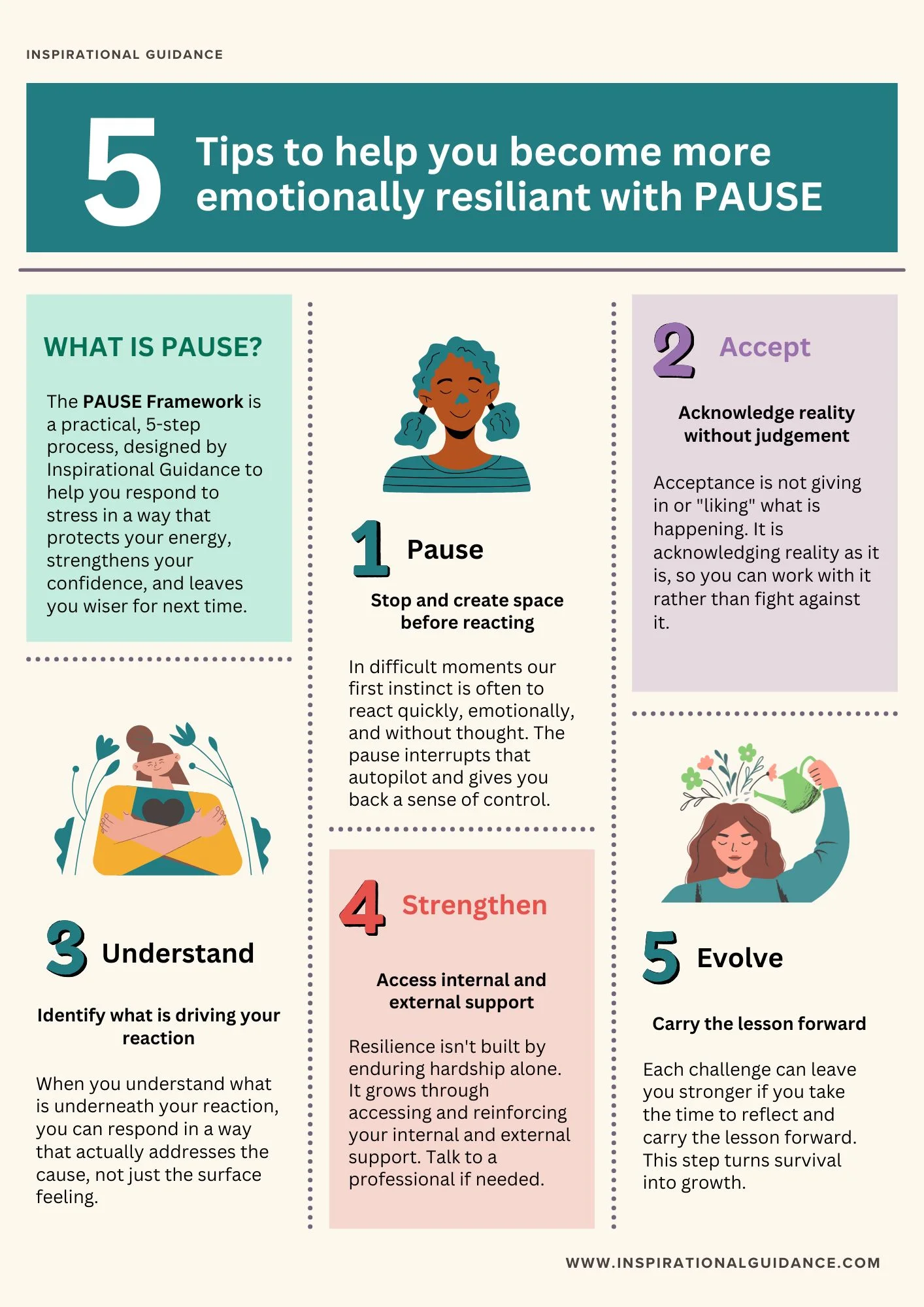
The PAUSE Framework is an original five-step process created by Diane Corriette to help you respond to stress in a way that protects your energy, strengthens your confidence, and leaves you wiser for next time. It was built on Diane's own experience of difficult moments and her work as a Personal Growth Coach, and refined over years of use with real women in real situations.
PAUSE is a practical, sequenced framework designed to be used in the moment, beyond reflection afterwards. You can run through it in 90 seconds or use it as the basis for a longer journaling session. Both approaches work.
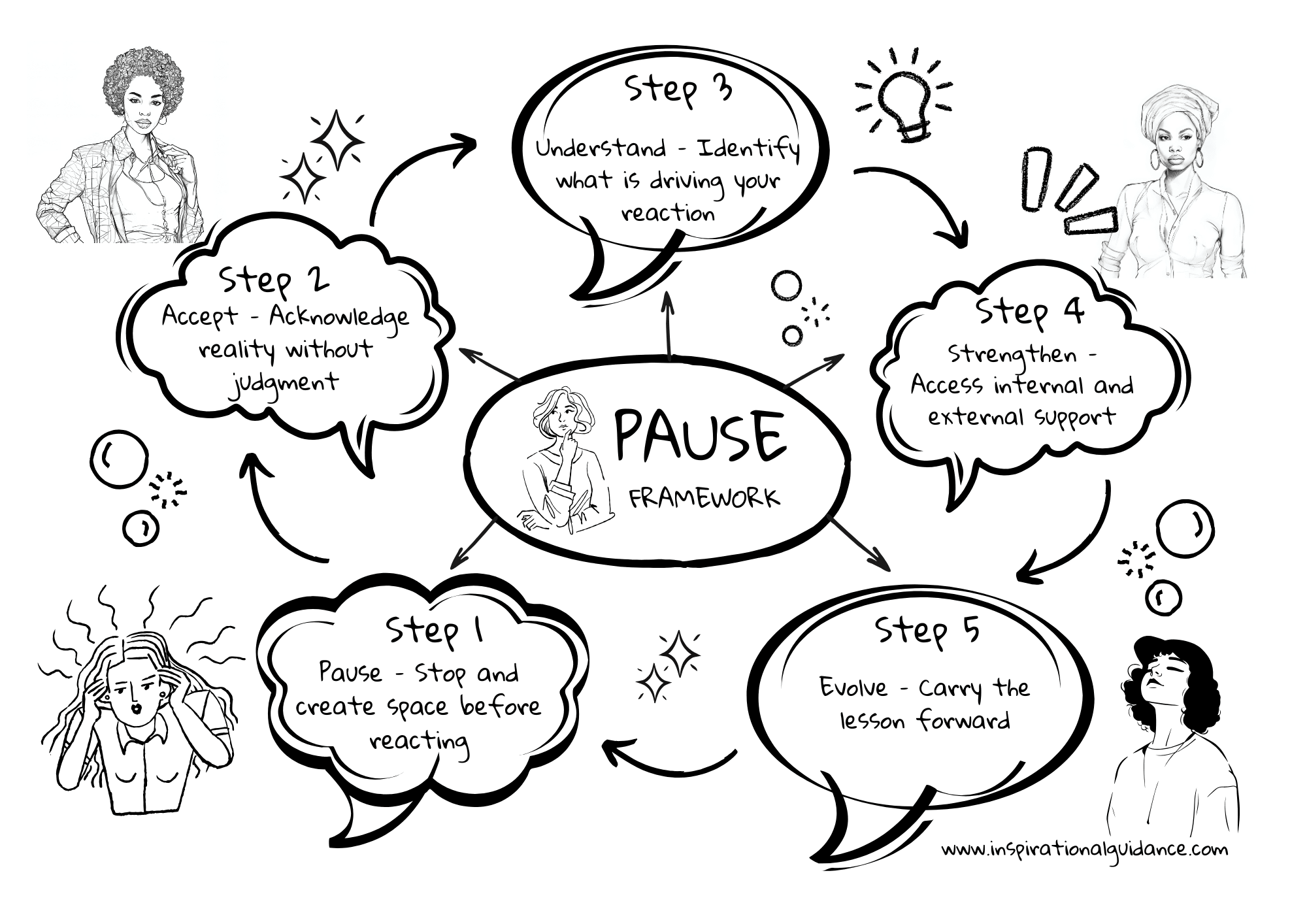
- Pause: Stop and create space before reacting.
- Accept: Acknowledge reality without blaming yourself.
- Understand: Identify what is driving your reaction.
- Strengthen: Access internal and external support.
- Evolve: Carry the lesson forward.
"Fall seven times, stand up eight."
- Japanese Proverb

The Five Steps
Step 1
Pause
Stop and create space before reacting. Breathe. Notice tension. Give yourself permission not to fix everything instantly.
Step 2
Accept
Acceptance is a different thing from agreement. It is acknowledging what is, so you can work with it rather than fight against it.
Step 3
Understand
Ask what is really underneath the reaction. Identify triggers and patterns so you address the cause, not just the symptom.
Step 4
Strengthen
Resilience grows by reinforcing inner and outer supports: grounding tools, encouraging self-talk, and trusted people.
Where PAUSE came from
My reaction was out of proportion to the problem but it was not really about the event. It was about all the stress I had been carrying without PAUSE.
That breakdown was my body's way of saying "Enough!" Looking back, I see it clearly: I was not resilient. I was surviving. Real resilience would have meant pausing earlier, acknowledging my limits and choosing habits that gave me strength, not drained it. That understanding is what led me to create the PAUSE Method.
I started building PAUSE as a practical sequence I could actually remember and use when I was stressed, and not only when I was calm. Over the years I refined it through my own life and through working with women facing the quieter but equally exhausting experience of feeling stuck and not knowing why.
Every step in PAUSE came from real experience: my own, and my clients'. That is why it works in the moment rather than only in hindsight. It was built for the moments when you need it most.
Pause
In difficult moments our first instinct is often to react quickly, emotionally, and without thought. That reaction is a normal job of the nervous system, which was designed for immediate physical threat, a job you are rarely facing. A difficult conversation, an unexpected setback, a sharp comment from someone you trust: these need a different kind of response.
The pause interrupts that autopilot and gives you back a choice. Try a slow breath: inhale for four counts, exhale for six. Drop your shoulders. Notice any urge to rush or speak. That 90-second window is often enough to shift from reactive to responsive. You are choosing, and you are not delaying.
Accept
Acceptance is a different thing from agreement. It does not mean giving in, tolerating the intolerable, or pretending things are fine. It is acknowledging reality as it is right now, so you can work with it rather than fight against it. Resistance to what is happening drains the energy you need to respond well.
In practice: name what is actually happening without making it bigger or smaller than it is. "This is difficult and I did not want it to go this way" is acceptance. "This is a disaster and I cannot handle it" is resistance in a different costume. Name the feeling, note the facts, and remind yourself: "This is how it is right now, and I can choose my next step."
Understand
Once you have paused and accepted what is happening, you can look underneath the surface reaction. Ask: What is really driving this? Is this about now, or is it echoing something older, a pattern, a fear, a wound that has been activated before?
Understanding does not require perfect self-knowledge. It requires honest curiosity. Often, the strongest emotional reactions are about what the situation means, or what it reminds us of, far more than the immediate situation itself. When you can see that, the reaction loses some of its power and your response becomes more deliberate.
Keep a brief note of the triggers and patterns you notice. Over time, these become the raw material for genuine self-knowledge: your own lived data.
Full guide: Understand, Finding the Why Beneath the Reaction →
Strengthen
Resilience does not grow from white-knuckling through hard moments. It grows from having reliable inner and outer resources you can reach when things are difficult. This step is about building and using those resources, consistently and not only in a crisis.
Inner resources: grounding tools (slow breath, a brief body scan, five things you can see right now), encouraging self-talk that coaches you instead of tearing you down, and a written record of how you have handled difficulty before. Outer resources: people you trust, routines that steady you, physical movement, and, for many women, journaling.
The Strengthen step is also where you ask: what do I need right now that I am not giving myself? Often the answer is simpler than expected: rest, space, a conversation, or permission to not have it all figured out today.
Evolve
Every difficult experience contains information. The Evolve step is where you decide what to do with it, rather than simply enduring it and moving on, or cycling back to the same pattern next time.
This is a long way from toxic positivity or forcing a silver lining. Some things are genuinely hard and leave a mark. Evolve means asking: what do I know now that I did not know before? What would I do differently? What does this tell me about what I need to protect, build, or change?
Capture one takeaway: a sentence in your journal, a note on your phone, a line in your weekly review. Over time, these become a resilience toolkit built entirely from your own experience. That is far more useful than generic advice, because it was earned.
Full guide: Evolve, Turning Survival and Challenges Into Growth →
Further Reading on Emotional Resilience
- Corriette, D. (2024). The PAUSE Framework for Emotional Resilience. Inspirational Guidance.
- Positive Psychology: Emotional Resilience overview
- American Psychological Association: Building Your Resilience
Featured Articles on PAUSE and Resilience
Pause: Why Slowing Down Is the First Step to Handling Any Challenge
The P in PAUSE: why stopping before you react works, and simple ways to rehearse the pause with your breath, your body and a physical
Accept: How Naming Reality Reduces Stress and Overthinking
The A in PAUSE: acceptance is not approval. Learn how naming what is true, dropping the 'should' and separating facts from stories cuts
Understand: Finding the ‘Why’ Beneath the Reaction
The U in PAUSE: look beneath a reaction to find what is really driving it. Simple questions and self-awareness habits for emotional
Strengthen: Building Your Resilience Muscle With Micro-Habits
The S in PAUSE: build resilience before the next challenge with micro-habits, support and calm practice rather than
Evolve: Turning Survival and Challenges Into Growth
The E in PAUSE: turn a hard experience into a lesson you can use. Reflect, record, apply and grow rather than just getting
Everyday Use Cases for PAUSE (And How to Handle Them Well)
The PAUSE framework is not only for crises. See how Pause, Accept, Understand, Strengthen and Evolve work in everyday
Emotional Resilience: The Skill That Helps You Bounce Back Stronger
Emotional resilience is not toughness or avoiding pain. It is recovering after life disrupts your plans, and it is built in ordinary
What Is The PAUSE Method
Reading time8 min Length1,750 words Last updatedOctober 11, 2026 LevelStep by step In this article The Inspirational Guidance PAUSE Framework for...
Step-Based vs Factor-Based Resilience: How PAUSE Works in Both (and Small Steps to Start)
Emotional resilience is a practice in the moment and a foundation over time. How PAUSE works as steps and as factors, plus seven small ways to start...
Journaling for Emotional Resilience: Journal Prompts for Women Ready to Take Back Their Voice
How journaling builds emotional resilience, four simple methods, and 24 journal prompts for women ready to reconnect with their own
Pause Before You Spiral: Language Shifts for Emotional Resilience
I used to think emotional resilience meant being stronger. I thought resilient people stayed calm, never cried, always knew what to say,...
State Management - The Quiet Skill That Changes Everything
I have walked into situations already defeated, not because anything had happened yet, but because of the way I felt walking in. My mind was running...
Living as an Example of Emotional Resilience: How Your Calm Becomes Contagious
When life gets tough, people tend to watch what you do, not just listen to what you say. The way you handle setbacks, disappointments, and daily...
The PAUSE Workbook
Take PAUSE further with the full 60-page workbook
The PAUSE Workbook goes well beyond this page. It includes a structured 30-day Resilience Routines plan, a daily tracker, weekly reflection prompts, grounding exercises, journaling scripts for each of the five steps, and a full Emotional Resilience Toolkit you can return to whenever things get hard.
It is designed to be used over time. Each section builds on the last, so by the end you have a resilience toolkit built from your own experience.
What's inside:
✓ Full PAUSE Method guide, one chapter per step
✓ 30-day Resilience Routines plan
✓ Daily Tracker and Weekly Reflection pages
✓ Journaling prompts for each of the 5 steps
✓ Grounding cards and calming scripts
✓ Visual reminders and affirmation tools
✓ Emotional Resilience Toolkit to keep and reuse
Quick Answers to Common Emotional Resilience Questions
What is emotional resilience?
Emotional resilience is the ability to adapt and recover when life does not go as planned. It is a skill you can strengthen with daily use. Learn more →
What is the PAUSE method?
The PAUSE method is a simple, five-step framework to help you respond to challenges with clarity instead of reacting on autopilot. Full guide →
How can I pause before reacting?
Take a slow breath, notice your immediate impulse, and give yourself permission to wait before speaking or acting. Step-by-step tips →
What is radical acceptance and how does it build resilience?
Radical acceptance means acknowledging reality as it is, without resistance, so you can work with it rather than against it. Read more →
How does self-awareness boost resilience?
Self-awareness helps you spot emotional triggers, patterns, and strengths, so you can respond instead of react. Find out how →
What micro-habits help build inner strength?
Daily gratitude notes, brief reflection breaks, and saying "no" now and then are small habits that add up to greater resilience. See more →
How can I turn setbacks into growth opportunities?
Reframe setbacks as feedback, extract one lesson, and apply it to your next action step. Growth guide →
How can the PAUSE method help me make better decisions?
By creating space between stimulus and response, PAUSE lets you choose actions aligned with your long-term values. Decision-making tips →
How can journaling improve emotional resilience?
Journaling helps you process emotions, track patterns, and build problem-solving skills over time. Journal prompts →
What small steps can I take to start building emotional resilience?
Begin with one small habit, such as a morning breath check-in or ending your day with a "win of the day" note. See examples →
Free Download: The PAUSE Framework For Emotional Resilience
A quick-start PDF to keep PAUSE at your fingertips. Print it, pin it, or save it to your phone for stressful moments.
FAQ
What is the quickest way to calm down during a stressful moment?
Use the Pause step: inhale for four, exhale for six, drop your shoulders, and delay responding for 90 seconds. That window is often enough to choose a better next step.
Is PAUSE a mindfulness technique?
PAUSE is mindfulness-friendly but more action-oriented. It gives you a simple sequence you can remember under pressure and apply in everyday situations.
How long does it take to build emotional resilience?
Resilience grows through repetition, not perfection. Most people notice a shift within a few weeks of small, daily steps, especially in the Strengthen and Evolve stages.
Can I use PAUSE at work or with family?
Yes. It is designed for real life: difficult meetings, parenting stress, health worries, and relationship tensions. Start with non-urgent moments to build the habit.
Who created the PAUSE framework?
PAUSE was created by Diane Corriette, Personal Growth Coach and founder of Inspirational Guidance. It was developed from over two decades of coaching experience and is the emotional resilience framework at the heart of her work with women.
Related Pillars
Reflection
This week, give yourself permission to pause before you respond. Note one thing you notice when you slow down.